Prosumer vs Commercial Espresso: Find Your Perfect Match
By Luca Moretti • 1st Jan
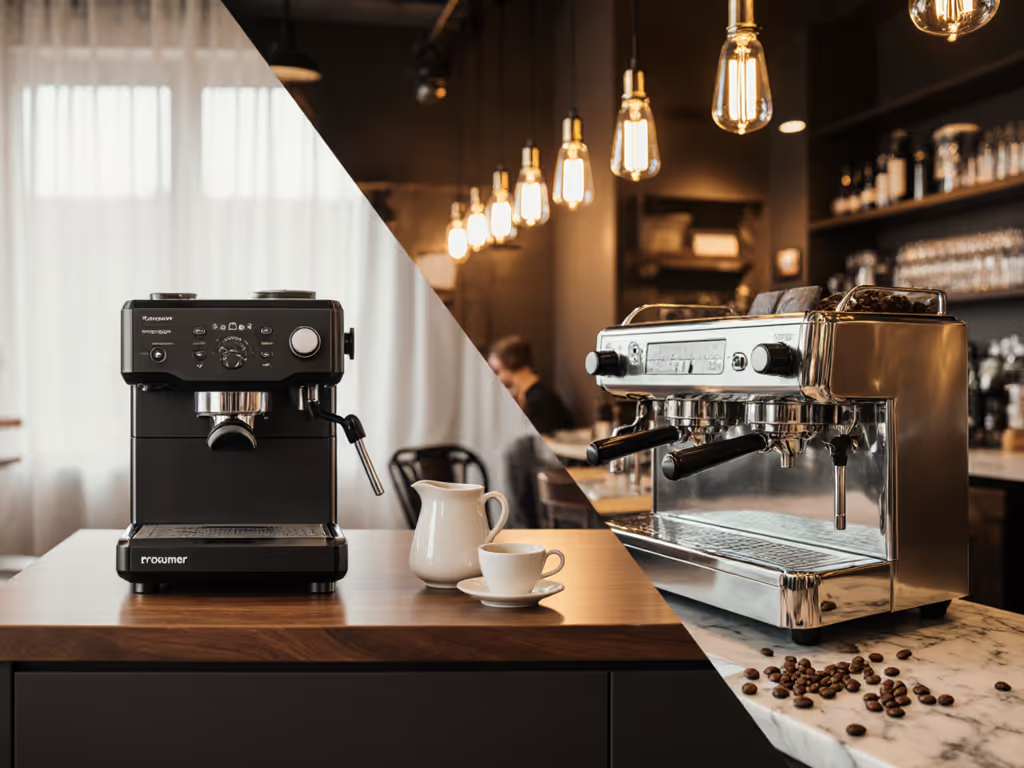
You're standing at the crossroads of coffee commitment, torn between a prosumer vs commercial espresso comparison that feels overwhelming. Is that shiny traditional espresso machine actually right for your apartment kitchen? You've done the research but hit analysis paralysis, with jargon, price tags, and conflicting reviews creating doubt where there should be morning clarity. What if the best choice isn't about specs alone, but about matching your machine to your actual routine? For a broader overview of machine categories and who they fit, see our manual vs semi-auto comparison. Let's simplify this decision with bounded options that produce dependable results, no more guessing, just the right tool for your daily ritual.
Why Constraints Create Confidence in Your Coffee Setup
I've coached hundreds through this exact dilemma. One memorable case stands out: a software engineer struggling with inconsistent shots despite owning a $3,000 machine. We put aside the manual and instead mapped his morning, two cappuccinos in eight minutes before his kids woke up. Suddenly, the machine's commercial-grade recovery time was irrelevant. His real need was predictability within constraints. That's when I pulled out my kitchen timer and three-setting card: dose, grind, time. Within 20 minutes, he'd locked in a repeatable morning workflow. The lesson? Bounded choices, repeatable shots, taste you can set a clock to.
Let's apply this same structured approach to choosing between prosumer and commercial equipment. Forget spec sheets for a moment. Let's build your decision framework step by step.
Step 1: Map Your Actual Morning Reality (Not Your Coffee Dreams)
Before considering machines, honestly answer these checkpoint questions:
- Time available: How many minutes from waking to first sip?
- Drink volume: How many back-to-back shots/milk drinks?
- Quiet hours: When does noise become problematic? If noise is a constraint, check our quiet apartment machine picks.
- Counter reality: What's your available depth (inches) and cabinet height?
- Skill focus: Do you value consistent results now or want to master every variable?
If you're dreaming of serving 12 friends during brunch but only drink two cappuccinos on weekdays, your actual needs dictate your machine, not the fantasy scenario. Many home baristas miss this critical distinction when considering a home barista to commercial transition.
Most home users fall into three buckets:
- The Efficient Duo: Two drinks in 8-10 minutes (70% of serious home users)
- The Solo Connoisseur: One meticulously crafted drink with tinkering time
- The Weekend Entertainer: Four+ drinks during relaxed gatherings
Your bucket determines whether commercial-grade recovery times (10 seconds between drinks) matter or if prosumer capabilities (30-second recovery) already exceed your needs. Recognize your true pattern before committing to hardware.
Step 2: Demystify the Technical Differences That Actually Matter at Home
Let's translate jargon into real-world impact through sensory anchors (what you'll actually taste and experience).
The Heating System: Temperature Stability vs. Your Morning Timeline
Commercial machines use triple boilers (espresso, steam, hot water) with copper heating elements designed for back-to-back service. Prosumer machines typically offer:
- Dual boilers: Separate espresso and steam boilers (best for 2+ drink households)
- Heat exchangers: Single boiler with heat exchange tube (budget-friendly but slower recovery) For a deeper dive into the trade-offs, compare heat exchanger vs dual boiler.
Critical insight: For one or two morning drinks, prosumer dual boilers achieve commercial-level temperature stability within your actual usage window. The difference only shows during extended sessions (4+ drinks). If steaming two milk drinks back-to-back creates bitter, flat shots, your machine lacks sufficient recovery, not because it is "prosumer" but because it's mismatched to your volume.
Steam Power: The Hidden Morning Killer
Commercial steam wands produce 1 to 2 oz/second. Prosumer machines typically deliver 0.5 to 1 oz/second. For two milk drinks:
- Commercial: 25-30 seconds total steaming
- Prosumer: 45-60 seconds total steaming
The reality check: Most home baristas need only 8 to 12 oz of textured milk total. Even prosumer steam power handles this in under 60 seconds when properly matched to your routine. If your morning feels rushed here, it's likely due to technique, not inadequate hardware.
Maintenance Complexity: Your Time Is Valuable
Commercial machines require daily backflushing, weekly grouphead gasket checks, and bi-annual boiler servicing. Prosumer machines simplify this with:
- Consumer-friendly maintenance cycles
- Longer-lasting components (3-5 year gaskets vs. commercial's 6-12 months)
- Quieter operation (vibratory vs. commercial rotary pumps)
Pro tip: If your desired outcome includes "cleanup measured in seconds, not minutes," prosumer machines often win with smaller drip trays and quieter operation that won't wake sleeping households. For step-by-step routines by machine type, use our maintenance guide by machine type.
Step 3: Calculate Your True Ownership Experience
Forget MSRP. Let's build your 5-year cost and effort forecast:
| Cost Factor | Prosumer Machine | Commercial Machine |
|---|---|---|
| Initial Cost | $1,500-$3,500 | $8,000-$20,000+ |
| Depreciation | 30-40% over 5 years | 60-70% over 5 years (commercial machine depreciation is steep) |
| Maintenance | $150/year (descaling, basic parts) | $500+/year (specialist servicing) |
| Counter Space | Fits standard kitchen depth (15-18") | Requires 22"+ depth + plumbing |
| Noise Level | 60-65 dB (quiet conversation) | 70-75 dB (disruptive in open plan) |
The Hidden Cost of Commercial Machines at Home
Commercial equipment comes with prosumer machine limitations when used residentially:
- Size mismatch: Requires permanent plumbing installation (not apartment-friendly)
- Overkill performance: Wastes energy heating unused capacity
- Service nightmares: Few technicians service commercial machines in residential areas
- Learning curve: Steeper maintenance requirements increase risk of costly errors
Consider this: A La Marzocco Linea Mini (commercial-inspired) costs $11,000 but requires professional installation. For that price, you could buy a $3,000 prosumer machine and a $2,000 grinder and have $6,000 for five years of café-quality beans. Which actually delivers better daily taste through repeatability? To understand ongoing electricity costs across heating systems, see our espresso energy cost analysis.
When Commercial Makes Sense for Home Use
Only consider commercial equipment if:
- You run a micro-café from home (with proper permits)
- You have dedicated coffee room space (200+ sq ft)
- Your morning routine involves serving 6+ people daily
- You're already a certified technician or have local service support
For all other home baristas, high-end prosumer machines deliver café-quality results within your actual constraints.
Step 4: Build Your Decision Framework With Sensory Anchors
Let's translate this into your personal decision matrix using calibration prompts. Score each factor 1-5 (5=most important to you):
- Morning time window (5=extremely tight, 1=leisurely)
- Consistency needs (5=must be identical daily, 1=enjoys experimenting)
- Space constraints (5=very limited, 1=dedicated coffee area)
- Budget reality (5=strict $1-3k limit, 1=invest in dream setup)
- Maintenance tolerance (5=prefer simplicity, 1=enjoys technical work)
Decision guide:
- Total score 20+: Prosumer machine is ideal (dual boiler recommended for scores 4+ on consistency needs)
- Total score 10-19: Mid-range prosumer (heat exchanger models)
- Total score below 10: Only consider commercial if you run a home café
If you're eyeing cafe startup equipment but working from home, remember: What works for a business doesn't necessarily serve your personal ritual. Your machine should enable, not complicate, your daily experience.
Your Perfect Match Awaits in the Constraints
The most transformative moment in coffee isn't when you buy the most expensive machine, it is when you find the tool that disappears into your routine. I've seen countless home baristas achieve café-quality results with $2,000 prosumer machines while $15,000 commercial units sit unused in corners. Why? Because the right machine works with your life, not against it.
Remember that engineer I mentioned earlier? His $3,000 machine was gathering dust until we aligned it with his bounded morning reality. Now, he locks the recipe, enjoys the routine, and serves his family consistently great coffee before the chaos begins. That is the real promise of the right machine, not commercial-grade specs, but confidence in every cup.
Your next step: Stand in your kitchen tomorrow morning with a timer. Brew exactly as you would on a typical weekday. Note where friction occurs (not in ideal conditions, but in your real morning). The gap between your current process and your desired outcome reveals your true machine needs better than any spec sheet ever could.
Related Articles